Science advances through discoveries, milestones, and breakthroughs. A publication that transforms a field, a discovery that opens up a new path, an innovation that changes practices: these advances reflect the vitality of the research conducted at the Université Grenoble Alpes. Discover the scientific work that drives knowledge forward, changes our perspective on the world, and helps build the solutions of tomorrow.
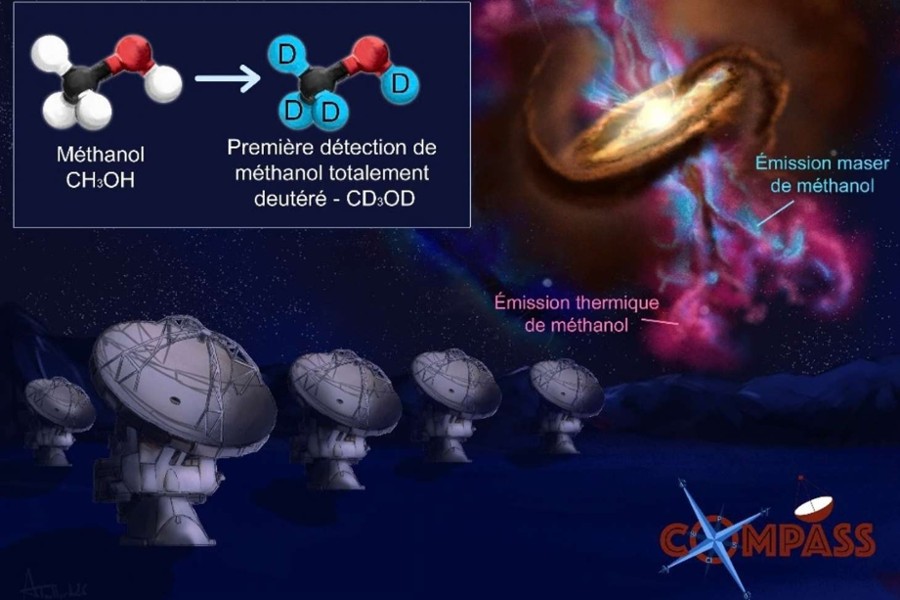
A major international program to observe very young stars—involving scientists from the Grenoble Institute of Planetology and Astrophysics—has released its first results. Thanks to ...
Astronomers finally have irrefutable proof that Betelgeuse, one of the most famous stars in the night sky, is not alone. Thanks to the European Southern Observatory’s (ESO) Very Large Telescope (VLT), ...
The enteric nervous system, often referred to as the “second brain,” autonomously controls the functions of the digestive tract. A study published in *Genes & Development* reveals that the LKB1 protein plays an essential role...
Holding a Junior Professor Chair at the Université Grenoble Alpes, physicist Boris Brun-Barrière explores how heat—the enemy of spin qubits—can also become an unexpected ally in the race...
Solving problems by harnessing the natural adaptability of bacteria. This is the challenge taken on by a research team coordinated by INRAE and involving the Université Grenoble Alpes, the Grenoble Alpes University Hospital...
After ten years of observations, an international team analyzed the HIP 41378 planetary system. Composed of at least six planets with exceptionally long orbits, this rare system is perfectly aligned with the Te...
In an article published in *Nature Communications*, scientists reveal the unexpected architecture of a key enzyme in bacterial respiration, type II NADH dehydrogenase. They highlight a scaffold...
For the first time, the rotation of a protoplanetary disk—where planets form—has been directly observed by mapping the emission from its dust grains. This is the disk surrounding the young star AB Aurigae....
Presented at OSDI 2026, one of the world’s most prestigious conferences on computer systems, the research by the group led by Alain Tchana, a professor at Grenoble INP – Ensimag, UGA, opens up new perspectives for...
To optimize CO2 sequestration in recycled concrete, researchers have shed light on the complex physicochemical mechanisms of carbonation using a unique 5D imaging technology developed at NeXT-Grenob...
For the first time, reference altimetric stations have been installed in the heart of the Antarctic ice sheet by a team from the Institute of Environmental Geosciences in Grenoble (IGE - CNRS/INRAE/IRD/UGA/Gre...
Published in the journal PNAS, a study explores the hypothesis that the early Earth’s magnetic field may have originated in the underground magma ocean that surrounded the core at the base of the Earth’s mantle. Thanks to...
Share the linkCopyCopiedClose the modal windowShare the URL of this pageI recommend this page:Available at this address:The page will then be accessible from your "My Favorites" menu.Stop the videoPlay the videoMutePlay audioChat: Have a question?Robo Fabrica ChatbotMatomo Traffic StatisticsX (formerly Twitter)